
Mouthguard for Boxing and MMA: How to Choose, Fit and Care for It
-
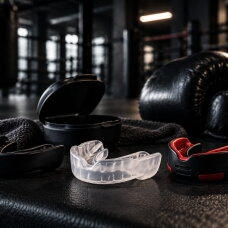
A mouthguard costs from 6 euros and a single implant about a thousand, so it is the first thing a coach tells you to buy before your first sparring. Yet many beginners mould it wrong, so after a month it ends up at the bottom of the bag. This guide explains how mouthguard types differ, how to mould one, which to choose for a child or with braces, and when to replace it.
Short answer
- First sessions – a boil-and-bite guard for 6–10 euros. It is fully adequate for boxing, kickboxing and MMA.
- Regular sparring – a multi-layer boil-and-bite guard with a harder outer shell (OPRO Silver, Gold).
- Kids – a junior size up to about age 10–11, then adult.
- Braces – a dedicated braces model that does not mould around the brackets.
Mouthguard types
Type How it fits Who for Price Ready to wear (Snap-Fit) Goes in straight away, no moulding Spare guard, first session when there is no time to mould 5–8 € Boil and bite (Self-Fit) Softened in hot water and bitten into shape Everyone who trains regularly 6–25 € Home custom fit (Instant Custom) Moulded with a special compound, grips like a dentist-made guard Sparring and competition, people standard guards do not fit 50–60 € Dentist-made custom Cast from a dental impression Professionals 150–300 € The difference between a cheap and a more expensive boil-and-bite guard is the layers: a cheap one is a single soft material, while a better one has a harder outer layer that spreads the impact and a soft inner layer that grips the teeth. The better guard is also thinner, so breathing and talking are easier.
How to mould a mouthguard: 6 steps
- Boil water and pour it into a mug. Wait 30 seconds so it cools slightly.
- Submerge the guard for the time the manufacturer specifies, usually 20–30 seconds. Left in too long, it stretches and thins out.
- Take it out, shake off the water and wait 2–3 seconds so you do not burn your palate.
- Place it on the upper teeth, bite down and suck hard to pull the guard against the teeth from the inside. Press it against the gums from the outside with your fingers.
- Hold for 30–60 seconds, then take it out and dip it in cold water to set the shape.
- Check: the guard should stay on the upper teeth with the mouth open and not move. If it drops, repeat from step one. Most models can be moulded 2–3 times.
Mould it after training, not before: the palate needs time to get used to it, and wear it for 10–15 minutes at home the first time.
Which to choose for boxing, kickboxing and MMA
For boxing and kickboxing any boil-and-bite guard works, because the strikes go to the face and the key thing is that it does not move. MMA and grappling need a thinner guard, because you breathe through your mouth while wrestling and a thick guard gets in the way. If you train 3 or more times a week, a multi-layer guard is worth the money.
In our range: to start, our own brand Royal mouthguard or OPRO Self-Fit Bronze; for regular sparring OPRO Self-Fit Silver and OPRO Self-Fit Gold; and for those standard guards do not fit, OPRO Instant Custom Lithuania with the Vytis. If you need one immediately without moulding, there is OPRO Snap-Fit. All models are in mouthguards.
Mouthguards for kids
Children up to 10–11 need a junior size: an adult guard is too long, reaches the throat and the child will not wear it. The moulding process is the same, just let the water cool a little longer. When the teeth are changing, the guard needs re-moulding and often replacing every six months. We have the Royal junior guard to start and OPRO Self-Fit Silver Junior and OPRO Gold Junior for regular training. The full category is kids' mouthguards.
Mouthguards for braces
A regular guard moulded around braces sticks to the brackets, and taking it out can pull a bracket off. A braces model has a thicker channel that is not moulded, covers the brackets and only forms against the gums. It needs re-moulding every few months when the orthodontist changes the wire. We stock the OPRO Self-Fit Gold Braces, suitable for upper and lower braces. Check with your orthodontist before buying, especially if you have a wire on the lower teeth.
Care and when to replace
- Rinse in cold water after training and dry it. Hot water deforms it.
- Keep it in a ventilated case, not at the bottom of the bag.
- Clean it once a week with a toothbrush and soap, or soak it in denture cleaner.
- Replace it when it cracks, when it starts moving on the teeth, or at least once a year. For kids, whenever the teeth change.
- Do not share it and do not chew it during training: that thins it out over the molars.
Frequently asked questions
Do I need a guard for the lower teeth too?
For boxing and MMA the upper one is enough: it absorbs the impact, and the lower teeth are protected by clenching the jaw. Double guards are used only with braces on both jaws and in some contact disciplines.Can I mould it a second time?
Most boil-and-bite models can be moulded 2–3 times. Cheap single-layer guards thin out after the second time, so it is better to buy a new one.Why does it make me gag?
It is too long and reaches the soft palate. Trim the ends by 2–3 mm with scissors and smooth the edges. If that does not help, choose a thinner model or a junior size for a small jaw.Which colour should I choose?
Any colour is fine for training. Some federations do not allow red or partly red mouthguards in competition because they look like blood, so check the rules before competing.Does a mouthguard prevent concussion?
It protects teeth, lips and jaw, and only partly reduces concussion risk by cushioning a blow to the lower jaw. What protects against concussions is technique and sensible sparring intensity.You can see and choose mouthguards at our store in Vilnius, Laisvės pr. 125A. For the rest of the beginner kit, see What You Need for Your First Boxing or Kickboxing Class.
