
How to Choose a Punching Bag: Hanging, Free-Standing or Water Bag
-
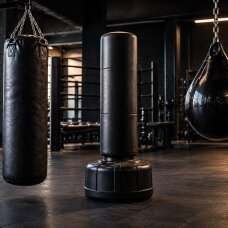
A punching bag is the one piece of boxing equipment you buy once for ten years, so a mistake is expensive: a bag that is too light flies around the room, one that is too heavy hurts your wrists, and a badly mounted bag can rip the hook out of the ceiling. This guide explains which bag to choose for your weight and height, how hanging, free-standing and water bags differ, and what you need to install one safely at home.
Short answer
- Home with nowhere to hang – a free-standing bag or dummy: no ceiling mount needed.
- Home with a solid ceiling or beam – a 120–150 cm hanging bag weighing about half your body weight.
- Gym, kickboxing or Muay Thai – a 180 cm bag so you can also train low kicks.
- Kids – a 90 cm bag or a free-standing kids' bag.
Bag weight: how many kilograms you need
The basic rule: the bag should weigh about half of the athlete's body weight. A lighter bag swings too much after a punch and does not let you work in combinations, while a bag heavier than you sends too much of the impact back into your wrists and elbows. If you kick, go slightly heavier than for hands only, because a kick hits harder.
Athlete's weight Recommended bag weight Suitable length Kids up to 40 kg 10–20 kg 60–90 cm 50–65 kg 25–35 kg 100–120 cm 65–85 kg 35–45 kg 120–150 cm Over 85 kg 45–60 kg 150–180 cm Kickboxing, Muay Thai (any weight) 40–60 kg 150–180 cm If you are torn between two weights, take the heavier one: it keeps its shape longer, and your punching power grows faster than you expect.
Hanging bag: the classic for the gym and home
A hanging bag is the most versatile: it swings, so you learn to keep distance and move, not just hit a static target. The length decides what you can train. A 90–120 cm bag is for hands only, 150 cm lets you kick up to body height, and a 180 cm bag, also called a banana bag, almost reaches the floor, so you can train low kicks to the thigh as well.
Check three things before buying:
- Filling. Cheaper bags are filled with textile scraps, better ones have a denser filling and several layers, so they do not sag to the bottom.
- Shell. Synthetic leather (PU) is the standard for home and gym training; natural leather lasts longer but costs twice as much.
- Mounting. Chains with a swivel hold better than straps, and the hook must go into a wooden beam or concrete. Plasterboard ceilings will not hold even a 30 kg bag.
Our own brand Royal hanging bags are priced with delivery included: Royal 120×40 cm with chains suits most beginners, Royal 150×40 cm is for kickboxing, and Royal 180×35 cm and Fairtex Banana Bag 180×36 cm for Muay Thai. To save on shipping there is also an unfilled Royal bag you fill yourself with old clothes and sand. All models are in the punching bags category.
Free-standing bag: when there is nowhere to hang
A free-standing bag sits on a heavy base you fill with water or sand, so there is no drilling and no landlord permission needed. It swings less than a hanging bag, which makes it better for combinations and hard single shots but teaches less footwork. Choose by height: an adult needs a bag at least 170 cm tall to punch at head level.
Our premium own brand Hitman makes free-standing trainers for home and gym use:
- Hitman free-standing bag Bag-Big 180 cm – a full-height bag with a heavy base, for hands and kicks.
- Hitman Punching Man Heavy and Punch Man Medium – height-adjustable dummies for aiming at the chin, liver and ribs.
- Hitman Rapid Reflex Boxing Bar – a reflex trainer for speed and reaction.
For a different budget or style we also carry Century BOB dummies and a free-standing kids' bag. See the full range in free-standing bags.
Water bag: easy on the wrists, hangs from a hook
A water bag is filled with water, so a punch feels like hitting a body rather than a hard bag: less shock to the wrists and elbows, a quieter session and a lower injury risk. You adjust the weight with the amount of water, and an empty bag weighs only a few kilograms, so it is easy to carry home and hang from a simple hook or beam. It is the best choice if you have wrist problems or train in a flat where noise matters.
Hitman water bags come in four sizes: 30.4×40 cm for kids and lighter athletes, 40×55 cm is the most versatile and popular, 45.72×59 cm for heavier athletes, and the elongated Bullet 34.8×74.7 cm also allows body shots. All of them are in water training bags.
Wall-mounted trainers and speed bags
If there is no room to hang or stand anything, a wall-mounted trainer takes only 30–40 cm. The Hitman wall dummy and the Fast Response Smart trainer are good for accuracy and combinations, while a speed bag builds rhythm and shoulder endurance. A speed bag is an addition, not a replacement for the main bag.
How to hang a bag safely at home
- Find a wooden beam or a concrete slab. Never mount into plasterboard or hollow blocks.
- Use a heavy bag mount with four bolts, not a single hook.
- The bottom of the bag should be about knee height and the top at head level. If it hangs too high, extend the chain.
- Leave at least a metre of free space around it so you can move in a circle.
- Check the bolts every day for the first week: the bag settles and the mount can loosen.
All mounts and swivels are in punching bag mounts.
What else you need with a bag
Only work the bag with wraps and gloves: 12–14 oz gloves suit most people, and we explain how to choose them in How to Choose Boxing Gloves. Wraps protect the wrist and knuckles (see our hand wraps guide), and if you do not want to wrap, gel inner gloves will do. A rubber mat under a free-standing base keeps the floor unscratched.
Frequently asked questions
Does a free-standing bag replace a hanging one?
For home training, yes. It swings less, so it teaches less movement, but it builds power, technique and endurance just the same. For gyms we still recommend hanging bags.Why is a water bag better than a regular bag?
A softer impact on the wrists, a quiet session and adjustable weight. The downside is that it needs to hang, although the hook requirements are lower than for a heavy bag.Which bag suits a child?
Up to age 10, a free-standing kids' bag or a 90 cm bag; from 10–12 by weight from the table. Kids must always train with gloves and wraps.Can a bag be kept outside or in a garage?
Synthetic leather tolerates cold but not moisture and sun: the shell cracks within a year. Keep a garage bag covered, and empty a water bag for the winter so it does not freeze.How long does a punching bag last?
With regular home training, 5–10 years. In a gym the filling settles in 2–3 years under heavy use, so we recommend heavier models and spare unfilled bags for clubs.If you are not sure which bag to choose, visit our store in Vilnius, Laisvės pr. 125A, and we will help you choose.
